Mobile-first website providing digital didactics in exhibition spaces.
A digital alternative to physical labels which can be adjustments to users’ needs (text size, language, level of education, audio)
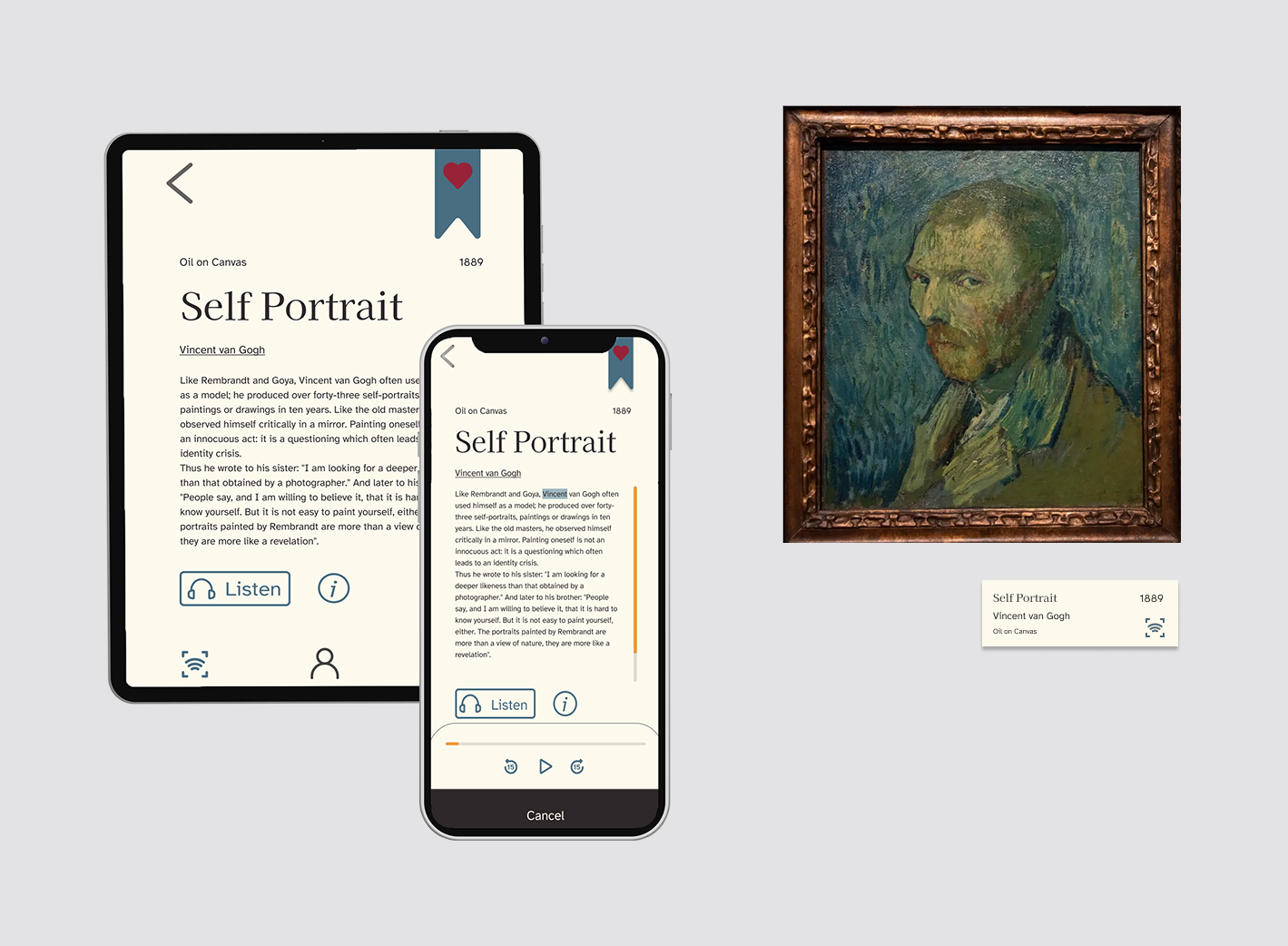
NFC tags enable visitors to scan and read the desired information from anywhere in the physical space
Scope: Capstone Project (1 academic year)
Team: Natalia Parraga
roles: User Researcher, Product Designer
Attendees and workers alike want more out of didactics.
Observational Research
Labels are Limited
Didactics provide context. They are typically in the institutions’ primary language(s), stationary, and relatively small.
Card-Sorting
More Information Please
Users accept any and all information in an exhibition space, but want more information when their interest was high.
Research Questionnaire
GLAM Workers Unsatisfied
Only 42.9% of workers in Galleries, Libraries, Archives, and Museums rated their exhibitions as somewhat accessible.
How might we develop hybrid (physical & digital) didactics to improve users’ accessibility?
1. Altering Physical Didactics
NFC Tags
Labels contain affordance to indicate scannability with mobile devices.
2. Creating Digital Didactics
ExhibitAccess
Mobile-first site and/or app contains relevant information and the ability to customize.
3. Increasing User’s Options
Accessibility
Users interact with digital or physical didactics according to their needs/wants.
Creating Intuitive Designs
Usability tests were run on paper prototype. Participants were invited to work through scenarios which included: scanning didactics, changing the language, bookmarking pieces, and listening to the audio of the didactics. Participants struggled with the save feature and how to scan an NFC tag.
User Flow Streamlined
Feedback from usability testing was applied for the following key scenarios: Scanning a Didactic, Onboarding, Creating a Profile, and Editing User Settings.
Accessible & Customizable
UI was developed to fit three default text sizes, in both light and dark mode to emphasize the customizable nature of the app.
Mobile-first, a Phygital Solution
ExhibitAccess is a digital tool to enhance physical user experience by increasing accessibility with a hybrid experience.
What I would do if I were to continue developing ExhibitAccess:
Develop the scannable NFC tags in the exhibition spaces: This integral part of the user journey was not developed due to timing constraints.
Conduct user testing with physical didactics, iterate more: While I believe the conceptual product to be effective, I’d like to validate my beliefs with real data and feedback.
Mobile prototype coaching users through their loneliness.
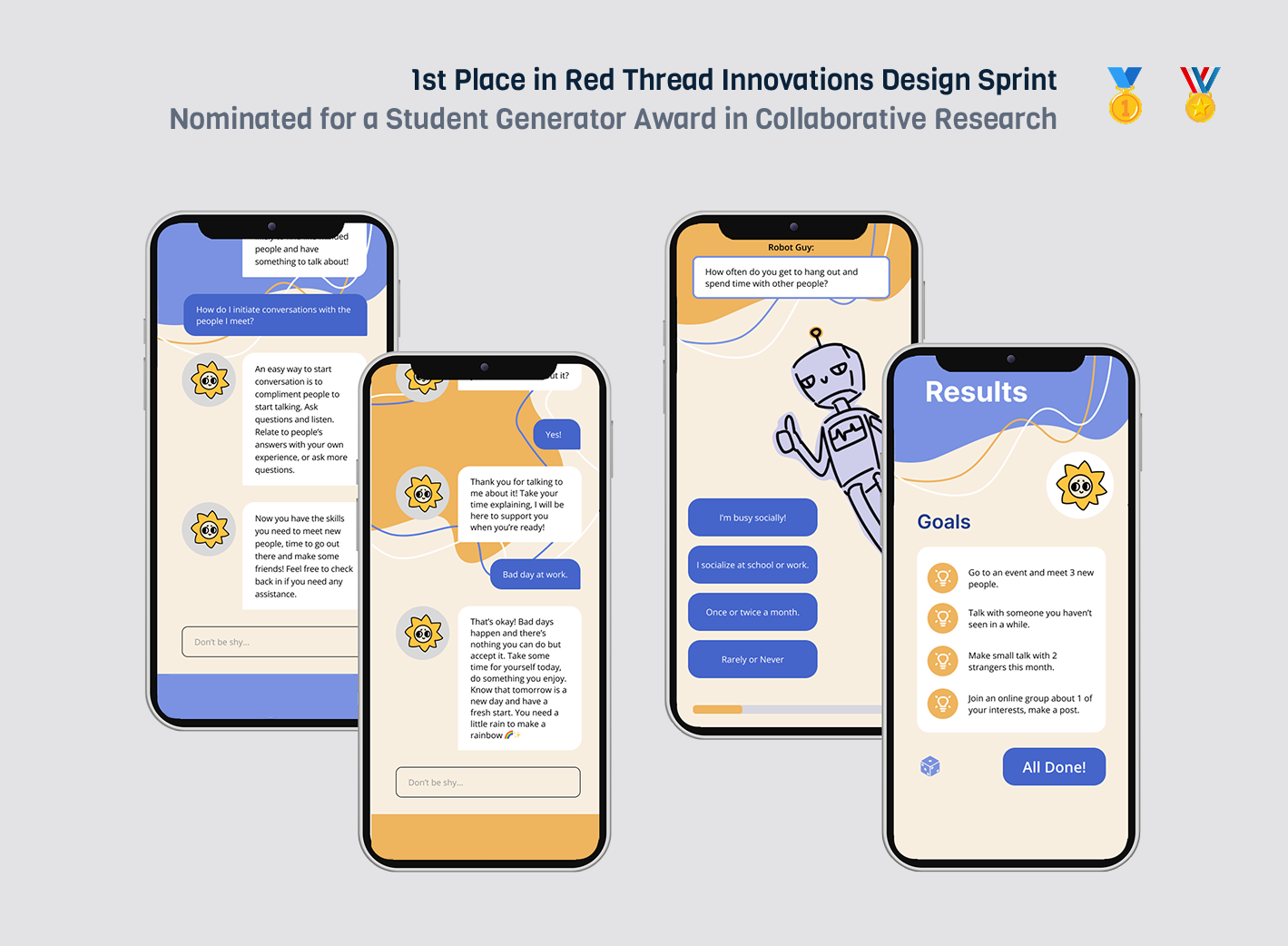
Sets customized goals for users to encourage the building of meaningful human connection.
Coaches users through conversational AI that provides guidance and support in alleviating loneliness.
Stimulating a listening friend, provides company and empathy for users looking to vent about their difficulties.
Character creation allows for user to build their companion.
Role: Project Manager, User Researcher
Scope: 4 months
Team: Natalia Parraga, Savannah Dalgado, Malcolm Darko, Jakob Visic
The Challenge: Solve for Loneliness by Developing a Digital Product.
More than 1 in 10 people aged 15 and older said that they always or often felt lonely (Canadian Social Survey, 2021).
Our task was to find a market that was unsaturated and projected to grow.
Understanding Lonely Markets
Mental Health
Those with depression, or any mental illness such as dementia, Alzheimer’s, etc.
Productivity
Those that struggle with balancing work and maintaining social relationships.
Mobile Users
Those who prioritize para-social connections: online relationships no genuine connection.
Young Adults
Those with weak social skills, especially the next generations who mature in the digital.
Mega Research Mural where we delegated research topics and collected findings for group discussion.
Digital product ideas were shared and organized into an Importance x Feasibility Matrix where we collectively defined our opportunity space.
Market Saturation: Chatbots for the Lonely
Character.ai
Users converse with user-made AI chatbots, with a focus on fictional characters and entertainment.
Replika
Modeled from real text conversations, allows users to practice social skills using GPT’s conversation model.
Xiaoice
Similar to Replika, has a 150 million userbase with some reports on para-social relationships.
Others
Woebot, Wysa, and x2ai: focused on mental health wellness, with a range of professional and human involvement.
Focus Groups: A Conversation with Character.ai’s Psychologist chatbot:
Preference for Non-Human Chatbot Characters
Participants felt more comfortable talking to a character rather than a “therapist” or chatbot posing to be human-like.
More Comfort Venting to a Chatbot over a Person
Some reported feeling at ease talking with the chatbot as there was no potential for human judgement.
Skeptical About AI’s Effectiveness, especially for those with Mental Health Issues
Concerns included misdiagnosis of mental health, the potential for users to get too attached to the chatbot, and replacing human connection with AI. Some participants described short-term relief but struggled to see the potential for a long-term solution.
Surveying Youth on AI and Loneliness
52.4% are open to having an AI chatbot to help with tasks/coaching
Only 23% are open to receiving psychological advice from an AI chatbot
61.9% currently use digital tools [social media, online communities, chatbots, chatrooms] for mental health help or alleviating loneliness
Digital tools were more likely to score lower in effectiveness than mental health counselling in alleviating feelings of loneliness
“I have not needed to use AI nor mental health services to alleviate loneliness, but I would be more than open to use an LLM, especially if it has been fined tuned for mental health support.”
“Obviously LLM can’t fully replace human connection right now, but the accessibility of AI makes it a quick tool for externalizing emotions.“
“I do play games and use social media when I’m not mentally well or feeling lonely, but I would not say that these digital tools are helpful for resolving my issues.“
Brand First Product: Creating Tomo’s Look and Feel
Low-fidelity prototypes were skipped as we understood chatbot user flow from market research. We felt that Tomo’s brand (writing and illustrations) would be more important than the UX design given the personal nature of the product.
Moodboard of Tomo prioritizes a friendly and calming feel.
Style tile of Tomo, a japanese word that means “my friend.”
Onboarding userflow that sets social goals and allows user to customize their coach.
Example user flow of user venting to Tomo, with a focus on conversational tone.
User flow of Tomo giving advice to user regarding pre-set goals, including gamifying social skills.
Iterative Design: Using User Testing Findings to Improve Tomo
Pains:
Onboarding Process: Overwhelming amount of text. Process felt long, and had no way of knowing when you would be done.
Lack of Flexibility/Personalization/Characterization: Desire for voice input option. Use of term “User” distracted participant. Desire for characters to be more interactive (animation, expressions, changes in illustrations).
Gains:
Character Customization: Appreciated illustrations and process of building a character.
Survey/Goals: Participants enjoyed seeing the result of their social placement survey. They could see themselves aspiring to reach social goals and using goal-tracking.
“It doesn’t make itself look like it’s trying to force you to fix your problems, but rather it gently holds your hand and guides you… It’s very nice.” – Participant
“I would use this.” – Ok Ikejiani, CEO of Red Thread Innovations
Tomo Becomes an Award Winning Product
We tied for first place in the design sprint and our research was nominated for a 2023 Student Generator Award in Collaborative Research.
REFLECTION On improving the Development Process
Define North Star: During the define phase, we had different perspectives as to what Tomo was. This made running progress meetings and establishing tasks as we transition into development more difficult.
Communication Clarity: Closer to the deadline, responsibilities became blurred. This caused repetition in output and affected the quality of our work.
Reflection On The product
Chatbot Psychosis: Since the development of Tomo, reports have come out of people reaching critical level in their mental health as a result of excessive use of chatbots. While we developed safe-guards against over-reliance in Tomo, it’s hard to say if this product would be welcomed in the current market.





You must be logged in to post a comment.